




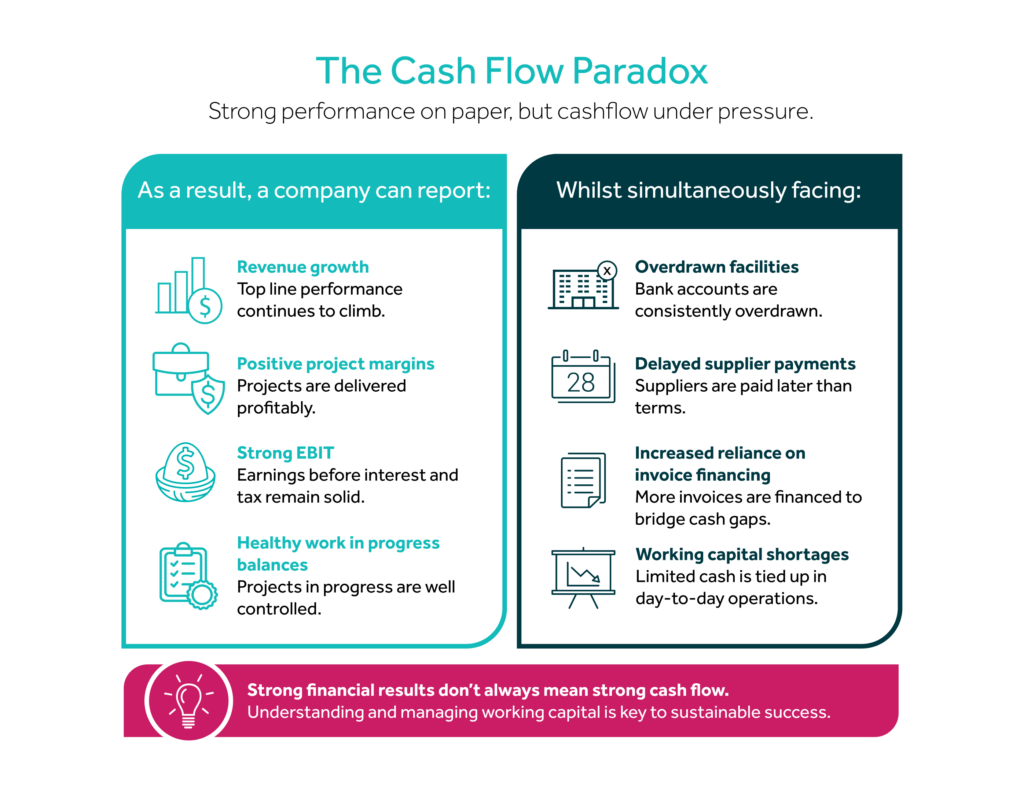
The Australian construction sector continues to face challenging conditions. Persistent supply chain disruptions, rising project complexity, labour shortages and increasing insolvencies have created an environment where many businesses are reporting profits while simultaneously experiencing cashflow stress.
For directors and CFOs, this raises an important question; how can a business be profitable on paper but still run out of cash?
The answer lies in understanding the significant differences between accounting profit and cash generation.
Revenue doesn’t pay the bills
Many construction companies focus heavily on revenue growth, project wins and reported profit. However, suppliers, subcontractors, employees, financiers and the ATO all require payment in cash – not accounting earnings.
In the construction industry and under AASB 15, revenue is generally recognised progressively as work is performed, and while this provides a fair representation of project performance, it also means profits may be recognised months before the corresponding cash is received.
The four biggest cashflow traps
1. Contract assets keep growing
Contract assets are common across the construction industry and represent revenue recognised but not yet billed or collected. Whilst contract assets are usually genuine, they can become problematic when they continue growing faster than cash collections.
Common warning signs include:
- Large, disputed claims
- Disputed claims tie up cash and increase delays in recovery
- Unapproved variations
- Work carried out without approval may not be recoverable
- Long-outstanding progress claims
- Delays in submitting or agreeing claims delays cash recovery
- Significant year end increases
- Large last-minute claims can indicate underlying issues and increase audit or recovery risk
A project may appear profitable, but until those amounts are collected, they cannot fund payroll, suppliers or debt repayments. Many construction failures begin with an over-reliance on balances that management assumes will eventually convert to cash.
2. Variations and claims are treated as cash
When forecasts include substantial recoveries from variations, extensions of time, delayed claims or disputed contract amounts, the timing often differs significantly from expectations.
A project forecast might show a healthy margin including claims and variations. The bank account, however, may tell a very different story.
Boards should regularly challenge whether forecast cash receipts are contractually enforceable, supported by documentation, agreed by the client or expected within the forecast period. If not, management may be relying on assumptions rather than cash.
3. Retentions create a hidden working capital burden
Significant to most construction businesses, retentions contribute to project profitability but are often withheld for extended periods after practical completion. Businesses that experience strong growth frequently overlook the cumulative impact of retentions. As turnover increases the retentions balance accumulates, cash remains trapped and funding requirements increase. The result is often a profitable business that requires progressively larger overdrafts and financing facilities simply to support growth.
4. Forecasted margins hide real project risks
With contract accounting for construction businesses being so heavily reliant on forecasting, the accuracy of the forecasts used is very important. Project profitability depends heavily on estimates such as costs to complete, labour productivity assumptions, material costs and subcontractor performance, each of which can significantly affect final project outcomes.
Where projects are under pressure, management may inadvertently overestimate future margins and underestimate future cash requirements, creating a dangerous situation where reported profits appear healthy, whilst actual cash performance deteriorates.
Why growth can make the problem worse
One of the most misunderstood risks in construction is that growth often increases cashflow pressure. Winning new and larger contracts generally requires additional labour, higher working capital, increased mobilisation costs and greater bonding and security requirements. The faster a construction business grows, the more cash it typically consumes, which explains why some of the most profitable construction companies still require invoice financing, bank facilities or alternative funding arrangements.
What resilient construction businesses do differently
The most resilient construction companies recognise that growth and profitability are only sustainable when supported by cash generation, and they focus on cash as much as they consider margins. From project managers through to CFOs and the Board they focus on:
- Closely monitoring contract asset ageing
- Challenging assumptions around claims and variations
- Tracking cash conversion metrics
- Stress-testing forecasts against downside scenarios
- Aligning operations and finance teams around cash collection
The old adage rings true: cash is king
Construction businesses rarely fail because of a lack of reported revenue. More often challenges arise when cash arrives later than expected, working capital expands faster than anticipated or projects consume more resources than originally forecast.
Proactively managing these common cash flow traps and identifying warning signs early is critical to maintaining profitability, supporting sustainable growth and building a resilient business.
At Nexia, we work with construction businesses to improve cash flow visibility, strengthen forecasting, optimise working capital and implement practical strategies that support long-term success. Whether you’re experiencing cash flow pressure despite strong profits, navigating a period of rapid growth or looking to enhance project performance and financial controls, our advisers can help you gain greater clarity, make more informed decisions and position your business for the future.
To learn how Nexia can support your construction business, contact our team here.